
Compound Range
Home Compostable Biocomposite Compounds
PLA-free. Certified home compostable. Runs on the line you already have.
The Material
Certified Home Compostable,
Not Only Industrial
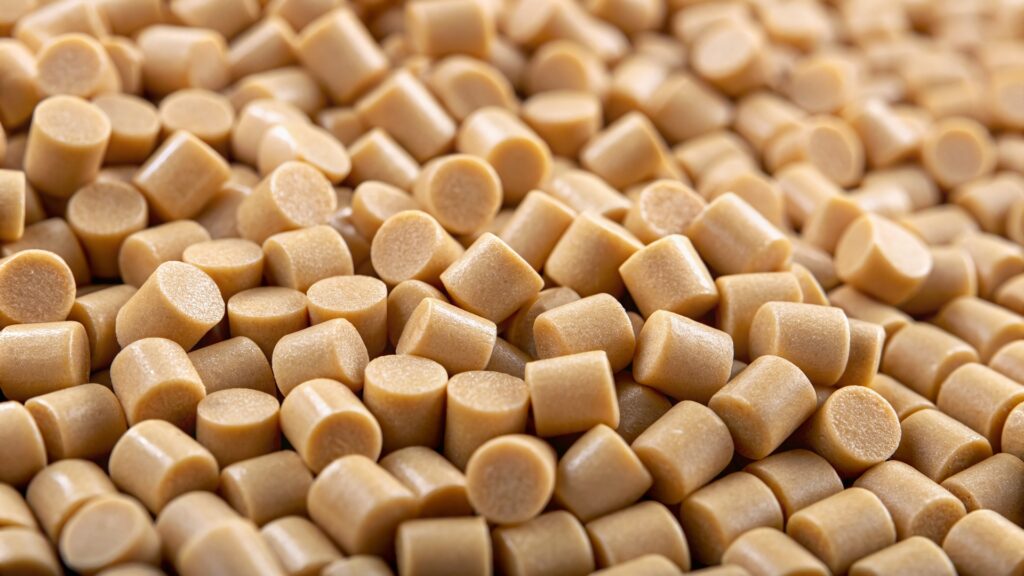
A home compostable biocomposite compound is finished pellets combining upcycled plant fiber with a compostable polymer matrix. The Biomera range is certified home compostable and industrially compostable, and runs on standard injection molding and extrusion equipment.
The range is PLA-free and designed for products that leave the user’s control after use, where home composting is a realistic end-of-life route and access to industrial composting cannot be assumed.
The compound replaces part of the fossil polymer in a part with upcycled agricultural biomass, which is where the decarbonization comes from. Carbon footprint performance can be evaluated according to ISO 14067, with third-party verification by BSI.
The material is a natural light brown with visible fiber. It takes pigment within that natural base tone, so clean whites and pale pastels are not achievable. For many applications the fiber texture is the point rather than a compromise.
You change material, not process. Tooling normally stays as it is, and the process settings move within the window published below.


Grade Data
Specification Values, Injection and Extrusion Grades
Specification values, converted to MPa. Every shipment is tested and released against these limits, and the release test report ships with the material. Injection and extrusion grades share a formulation family and differ mainly in flow.
| Property | Test method | Injection grade | Extrusion grade |
|---|---|---|---|
| Tensile strength | ASTM D638 | ≥ 31.3 MPa (320 kg/cm²) | ≥ 31.3 MPa (320 kg/cm²) |
| Elongation at break | ASTM D638 | ≥ 4.0% | ≥ 7.0% |
| Flexural strength | ASTM D790 | ≥ 52.9 MPa (540 kg/cm²) | ≥ 52.9 MPa (540 kg/cm²) |
| Flexural modulus | ASTM D790 | ≥ 1,941 MPa (19,800 kg/cm²) | ≥ 2,080 MPa (21,220 kg/cm²) |
| Notched impact, 23 °C | ASTM D256 | ≥ 53.9 J/m (5.5 kg-cm/cm) | ≥ 71.0 J/m (7.25 kg-cm/cm) |
| Density | ASTM D792 | 1.52 to 1.58 g/cm³ | 1.52 to 1.58 g/cm³ |
| Filler content | ASTM D2584 | 31.3 to 35.3% | 31.5 to 34.5% |
| Melt index, 190 °C / 2.16 kg | ASTM D1238 | 8.0 to 12.0 g/10 min | 1.6 to 2.2 g/10 min |
Processing
Processing Conditions
Both grades run on standard equipment. Drying matters more than with an unfilled resin, because plant fiber holds moisture and undried material will show it in the surface.
| Parameter | Value |
|---|---|
| Drying | 80 °C for 2 to 4 hours |
| Rear zone | 165 to 175 °C |
| Front zone | 175 to 185 °C |
| Mold temperature, injection grade | 30 to 50 °C |
| Water bath temperature, extrusion grade | 30 to 50 °C |
| Storage | Sealed, below 60% relative humidity, around 25 °C |
| Shelf life, unopened | 24 months from the date of manufacture |
Choosing a Grade
Which Grade for Which Process
Injection molding grade
- Higher flow, for filling thin sections and detailed cavities
- Melt index 8.0 to 12.0 g/10 min at 190 °C / 2.16 kg
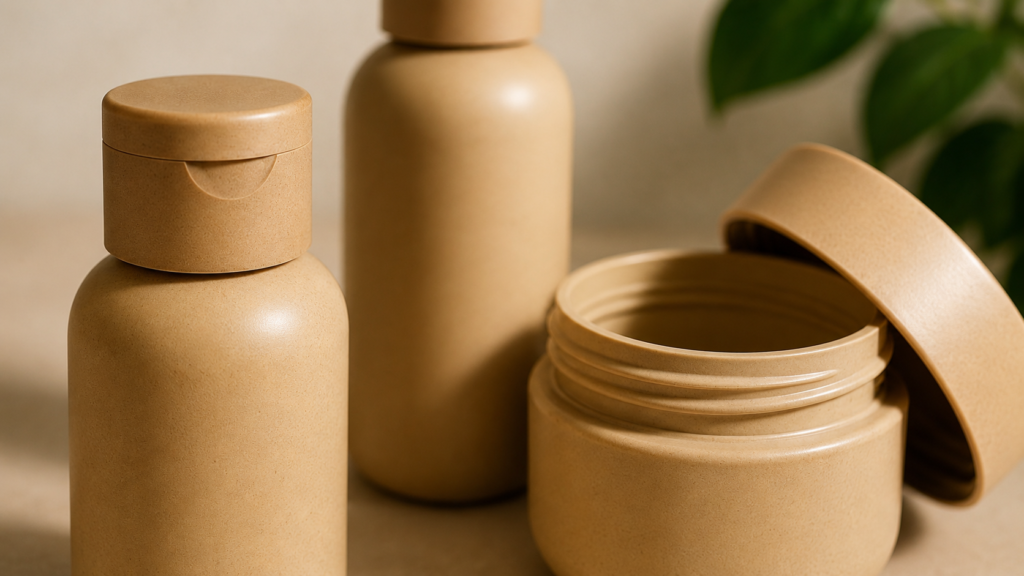
- Suited to rigid parts, closures, cosmetic components and consumer goods
- Mold temperature 30 to 50 °C
Extrusion grade
- Lower flow, for melt strength and dimensional hold as the profile leaves the die
- Higher elongation, impact and stiffness of the two
- Suited to sheet, profile and tube
- Water bath 30 to 50 °C
End of Life
Compostability and Disposal
The compound is certified home compostable under the OK compost HOME scheme and industrially compostable under OK compost INDUSTRIAL, and it is certified to ASTM D6400 for commercial composting. The certification is held on the material itself, in resin and granulate form, not only on a finished article.
Home composting is the harder of the two conditions, because it is assessed at ambient temperature rather than at the 58 °C held inside an industrial plant. A material that passes it also satisfies the industrial route, which is why this range covers both disposal paths rather than forcing a choice between them.
Certificates are shared under a non-disclosure agreement.
Applications
Where the Range Is Used
Reusable parts are a normal use for this range. Whether a given application is classed as single use or reusable depends on the part and how it is produced, and that classification changes which rules apply to it. We work that through with you before quoting.
Food contact status is assessed per part and per market, because the applicable rules depend on the product, the process used to make it and where it is sold. Tell us the application and the markets and we will confirm what is achievable and supply the supporting evidence your own declaration of compliance needs.
Ideal Applications
- Rigid packaging and closures
- Cosmetic and personal care components
- Consumer goods and giftware
- Horticulture and garden products
- Sheet and profile for short-life applications
Documentation
Data and Documentation on Request
- Full technical data sheet and the release test report for your shipment
- Compostability certificates for the material, home and industrial
- Confirmation that the formulation contains no intentionally added PFAS
- Processing guidance for your machine and part
- Test evidence for your own compliance file
- Trial quantities for qualification before a grade is fixed
For a part already in production on a polymer you do not want to change, the bio-based masterbatch route is usually faster. See the full materials range.
Common Questions
Home Compostable Compound, Answered
What is a home compostable biocomposite compound?
Finished pellets combining upcycled plant fiber with a compostable polymer matrix, formulated to break down in an unheated domestic compost heap rather than only in a heated industrial plant. It runs on standard injection molding and extrusion equipment.
Does the range contain PLA?
No. The range is PLA-free.
Which grade do I need for injection molding?
The injection grade. It has the higher flow of the two, which is what fills thin sections and detailed cavities. Its melt index is 8.0 to 12.0 g/10 min at 190 °C / 2.16 kg.
Do I need new tooling?
Normally no. Tooling stays and process settings move. Drying at 80 °C for 2 to 4 hours matters more than with an unfilled resin, because plant fiber holds moisture.
Is the material certified compostable?
Yes. The compound is certified home compostable under the OK compost HOME scheme, industrially compostable under OK compost INDUSTRIAL, and certified to ASTM D6400. Certificates are available on request and shared under NDA.
Can I get the full technical data sheet?
Yes, on request. The specification values are published above. Every shipment also carries its own release test report.