
Development Platform
Bio-Based Masterbatch for Conventional and Biosourced Polymers
Bio-Based Masterbatch
Biomass Masterbatch, Co-Developed for Your Polymer
A bio-based masterbatch is a pelletized concentrate that carries upcycled agricultural biomass into a host polymer, replacing part of the virgin resin in the finished part.
Biomera masterbatches are customized. We formulate each one around your target polymer and your technical and decarbonization objectives, then work as a co-development partner through trials to a qualified grade. That is different from buying a stock concentrate, and it is deliberate: carrier resin, feedstock, biomass loading, fiber morphology and coupling system all depend on what you run and what the part has to do.
The platform is not open-ended. Every project starts from the same base and varies across a defined set of parameters.
| Parameter | What is fixed | What we set together |
|---|---|---|
| Feedstock | Upcycled agricultural byproduct, never purpose-grown | Which one, chosen for color, odor and processing behavior |
| Host polymer | Conventional and biosourced resins both supported | The carrier resin, matched to your base polymer |
| Biomass loading | Concentrate up to approximately 70 wt% | Your final loading, typically 20 to 50 wt% |
| Biochar | Available as an option | Whether to include it, and at what loading |
| Supply format | Concentrate pellets or ready-to-mold compound | Which of the two suits your process |
Compatible Polymers
Conventional and Biosourced Host Resins
The masterbatch is engineered around the polymer you already run. We work with conventional and biosourced resins, including:
| Family | Polymers |
|---|---|
| Polyolefins | PP, PE, HDPE, LDPE |
| Engineering thermoplastics | ABS, PA (polyamide) |
| Biosourced and biodegradable | PLA, PBS, PHA, and other bio-based polymers |
| Other systems | Assessed against your resin and process |
Because the carrier resin has to be compatible with your base polymer, and because coupling systems differ between polyolefins, polyamides and biopolyesters, the formulation is specific to the resin family. This is the main reason a single off-the-shelf grade would not serve you well.
Biomass Feedstocks
What Goes Into the Masterbatch
The biomass is agricultural and food-industry byproduct, upcycled rather than purpose-grown. Feedstock choice affects color, odor, fiber morphology, processing window and cost, so it is selected against your application rather than fixed in advance. Every feedstock below is an existing residue stream, not a purpose-grown crop. Some are held as standard; others are available on request and may carry a higher minimum order.
| Feedstock | Residue stream | Availability |
|---|---|---|
| Sugarcane bagasse | Sugar milling | Standard |
| Coffee grounds | Beverage production | Standard |
| Used tea leaves | Beverage production | Standard |
| Bamboo | Forestry and processing | Standard |
| Wood chips | Wood and pulp processing | Standard |
| Rice husks | Rice milling | Standard |
| Grape pomace | Winemaking | On request, higher minimum order |
| Fruit pomace | Juicing and food processing | On request, higher minimum order |
| Wheat straw | Cereal harvest | On request, higher minimum order |
| Pineapple leaves | Fruit harvest | On request, higher minimum order |
| Algae | Extraction residues and bloom clearance | In development |
| Flax | Fiber and seed processing | In development |
Full details of feedstock selection and treatment are on our technology page.
Formulation Control
Blending and Particle Size
Two levers shape how a compound performs and how the finished part looks. Both are set during development rather than fixed in advance.
Feedstocks can be blended. A single formulation can combine two or more biomass sources, so one carries the mechanical contribution while another delivers the color, speckle or texture the part needs. Coffee grounds, bagasse and grape pomace look visibly different in a molded part, and for a consumer-facing product that difference often matters as much as the mechanical data.
Particle size is selected, not inherited. Biomass fillers range from coarse particles down to sub-micron. We work across that range, so the size is chosen against your target rather than dictated by what is on the shelf.
| Particle scale | Best for | Trade-off |
|---|---|---|
| Coarse | Flexural strength and stiffness, visible natural texture, lowest cost | Rougher surface finish |
| Micron | Most injection molding and extrusion applications | Neither the stiffest nor the smoothest |
| Sub-micron | Smooth finish, subtle or near-invisible speckle, film and narrow-nozzle processes | Higher energy input, more compatibilizer, more prone to agglomeration |
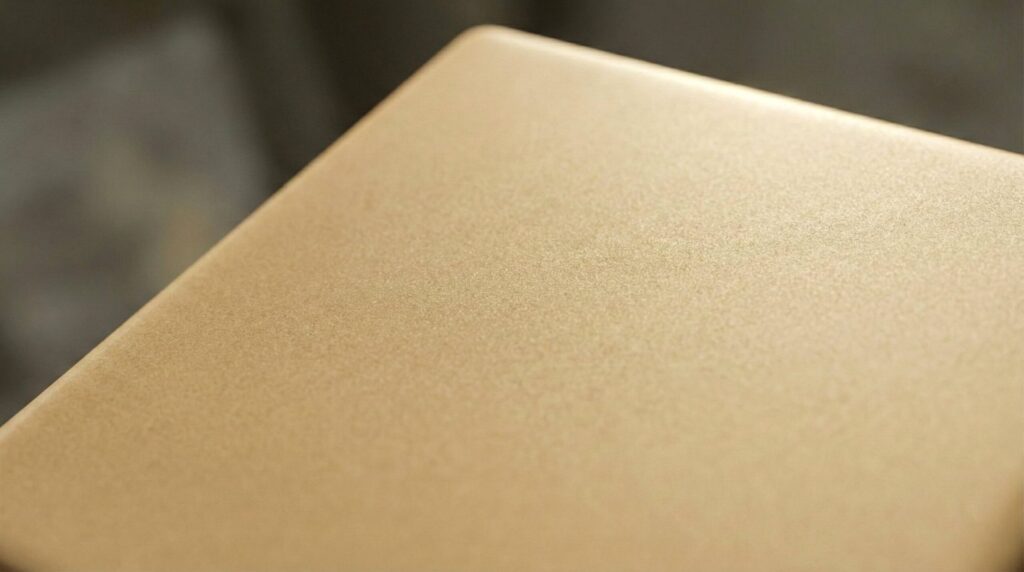
Particle size changes the technical result, but not in one direction. Finer particles increase surface area, which improves dispersion and gives a smoother finish and thinner achievable sections. Coarser particles often give better flexural stiffness. Which effect dominates depends on the carrier polymer, the biomass and the interaction between them.
That is why particle size is a development parameter rather than a published specification. We set it against your target and confirm it by trial.
Optional Addition
Biochar in the Formulation
Biochar is the solid carbon residue left when biomass is pyrolyzed in a low-oxygen atmosphere. In a thermoplastic compound it behaves as a rigid reinforcing filler, and it can be included in a Biomera masterbatch where the application calls for it.
How biochar behaves in a thermoplastic compound. These are directions of effect: the magnitude depends on the loading, the host polymer and the biochar itself, and is established by trial.
| Property | Typical effect |
|---|---|
| Elastic modulus | Increases |
| Tensile and flexural strength | Often improved at loadings of roughly 10 to 30 wt% |
| Impact strength and ductility | Reduced, through stress concentration and restricted chain mobility |
Returns diminish above roughly 20 to 30 wt% in most systems, and brittleness becomes the limiting factor. Results also depend on dispersion quality, interfacial bonding and the pyrolysis conditions the biochar was produced under. Those are variables a trial resolves, which is why we do not publish a single figure for a biochar-filled grade.
Biochar quality and origin can be specified as part of the development scope. The European Biochar Certificate is the recognized European framework and explicitly covers industrial applications including plastics.
How Development Works
From Enquiry to Qualified Grade
- Technical discussion to define the target specification.
- Scoped development proposal covering formulation strategy, indicative trial matrix, testing scope, deliverables, timeline, development fees and commercial terms.
- Your approval, then formulation and trial batches.
- Samples and testing, then validation.
- Grade-specific technical data sheet based on measured results, with processing recommendations and a mechanical test report.
- Scale-up to repeatable supply.
Development normally runs under a mutual NDA. Detailed formulation work and trials begin after approval of the development proposal and its commercial terms.
Let-Down Ratios
Indicative Starting Points
Mass-balance figures for a concentrate at 70 wt% biomass loading. These are arithmetic, not validated performance recommendations, and are subject to compounding and trial validation.
| Target final loading | Concentrate required |
|---|---|
| 20 wt% | 28.6 wt% |
| 30 wt% | 42.9 wt% |
| 40 wt% | 57.1 wt% |
| 50 wt% | 71.4 wt% |
At higher loadings a fully compounded ready-to-mold grade can give more consistent results than a let-down approach. We evaluate both routes during development.
What We Can Deliver
Documentation and Evidence
A development program produces evidence, not just material. These are the deliverables that can be included in scope, agreed before any technical work begins.
- Application-specific formulation for your polymer system
- Grade-specific technical data sheet from measured results
- Mechanical test report: tensile, flexural, impact, elongation, density and melt flow rate under stated methods
- Biomass content documentation based on formulation mass balance
- Independent verification of biogenic carbon (ASTM D6866 or EN 16640) or total bio-based content (EN 16785-1)
- Life cycle inventory data supporting a formulation-specific cradle-to-gate product carbon footprint aligned with ISO 14067
Biogenic carbon methods measure a carbon fraction, not biomass weight percentage. They are different numbers and we report them separately.
What You Receive
Packaging, consumer goods, automotive components and construction. Anywhere an existing polymer application needs a lower fossil content without changing the product or requalifying a new material.
Ideal Applications
Common Questions
Masterbatch Development, Answered
Which polymers can a Biomera masterbatch be used with?
Every masterbatch is formulated for a single host polymer, so there is no stock range and no special-order tier. We work across polyolefins (PP, PE, HDPE, LDPE), engineering thermoplastics (ABS, PA) and biosourced polyesters (PLA, PBS, PHA). Tell us the resin you run and the carrier and coupling system are built around it.
Can I buy a standard bio-based masterbatch from Biomera?
Not from stock. We formulate for your polymer and process, because the carrier resin, feedstock and coupling system depend on what you run.
Which biomass feedstocks are available?
Sugarcane bagasse, coffee grounds, bamboo, wheat straw, grape pomace, rice husks, pineapple leaves, fruit pomace, used tea leaves and wood chips are in production. Algae and flax are in development.
Can biochar be included?
Yes. Biochar acts as a rigid reinforcing filler that raises modulus, at the cost of impact strength and ductility. The loading is set by trial.
How fine can the biomass filler be?
From coarse particles down to sub-micron. Finer particles give a smoother finish; coarser particles give better flexural stiffness. Size is selected during development against your target.
What let-down ratio should I use?
As a mass-balance starting point, a 70 wt% concentrate added at 28.6 wt% gives a 20 wt% final loading. The working ratio comes out of trials.
Does a masterbatch make my product compostable?
No. The finished part follows the end-of-life behavior of the host polymer. For a compostability claim you need a compostable compound.
How is the carbon footprint calculated?
Through life cycle inventory data supporting a cradle-to-gate product carbon footprint aligned with ISO 14067, scoped per project.