GreenHub
ISO 14067 for Plastics: How a Product Carbon Footprint Works
ISO 14067 is the international standard for calculating the carbon footprint of a product: the sum of its greenhouse gas emissions and removals, expressed in kilograms of CO₂ equivalent (CO₂e). For a plastic material, the result is usually a cradle-to-gate footprint per kilogram of granules, which the standard calls a partial carbon footprint.
More and more manufacturers now ask their material suppliers for this figure, because it feeds the footprint of their own products and their Scope 3 reporting. This guide explains what ISO 14067 requires, how the footprint of a plastic material is calculated, why biogenic carbon can change the result for bio-based and biomass-filled materials, and what to check on a supplier’s product carbon footprint (PCF).
Key points
- ISO 14067:2018 sets the rules for quantifying a product carbon footprint. It covers climate change only and excludes offsetting.
- For a plastic material, the usual result is a partial footprint, cradle-to-gate, per kilogram of granules at the factory gate.
- Emissions and removals of biogenic carbon must be documented separately from fossil emissions. For a biomass-filled compound, the figures with and without biogenic removals can differ by a third.
- There is no ISO 14067 certificate as such. A footprint is critically reviewed, or verified by an independent body under ISO 14064-3.
- ISO and the GHG Protocol are revising their product standards together. The 2018 edition remains the reference until a new one is published.
What is ISO 14067?
ISO 14067, “Greenhouse gases: Carbon footprint of products: Requirements and guidelines for quantification”, was published in August 2018 and replaced the technical specification ISO/TS 14067:2013. ISO last confirmed it in 2024. It applies the life cycle assessment method of ISO 14040 and ISO 14044 to a single impact category: climate change.
Three things are outside its scope: offsetting, the communication of footprint figures (covered by ISO 14026), and every other environmental impact, such as water use or toxicity. A product carbon footprint therefore says nothing about recyclability, compostability or microplastics. It answers one question: how many kilograms of CO₂e does this product carry?
A revision is underway. On 9 September 2025, ISO and the GHG Protocol announced a partnership to harmonize their standards, and a joint working group is now aligning ISO 14067 with the GHG Protocol Product Standard. Until a new edition is published, ISO 14067:2018 stays in force.
Full or partial footprint: what applies to a plastic material
ISO 14067 distinguishes two results:
| Carbon footprint of a product (CFP) | Partial carbon footprint (partial CFP) | |
|---|---|---|
| What it covers | The whole life cycle, from raw materials to end of life (cradle-to-grave) | Selected stages only, usually raw materials to the factory gate (cradle-to-gate) |
| Unit | A functional unit, for example one molded part used for five years | A declared unit, for example 1 kg of granules |
| Typical use | Finished products: a part, a package, a device | Intermediate products: polymers, compounds, masterbatches |
A material supplier cannot know how its granules will be used or disposed of: the same compound can become a car part used for fifteen years or a single-use cup. That is why material footprints are almost always partial, cradle-to-gate, per kilogram. Your own footprint then adds the stages you control: transport to your plant, processing, use and end of life.
A cradle-to-gate footprint of a plastic material typically covers:
- Raw materials: producing the polymer, fillers, additives and pigments, including their own upstream emissions.
- Inbound transport of those raw materials to the compounding site.
- Compounding: the electricity and heat used to make the granules, plus packaging and production waste.
Transport to the customer can be added, but sector guidelines such as the chemical industry’s TfS PCF Guideline ask for it to be stated separately.
How an ISO 14067 footprint is calculated
The method follows the phases of life cycle assessment, and ends with a report:
- Goal and scope. Define the product, the declared or functional unit, the system boundary and the cut-off rules. Where product category rules for carbon footprints (CFP-PCR) exist for the product, they should be used.
- Inventory. Collect quantities of each raw material, energy, transport and waste. Primary data are measured on site; secondary data come from LCA databases such as ecoinvent, or from the footprints of upstream suppliers.
- Allocation. When a process makes several products, its emissions are shared between them: avoid allocation where possible, otherwise share by a physical relationship such as mass, and only then by economic value.
- Impact assessment. Each greenhouse gas is converted into CO₂e with the IPCC’s 100-year global warming potentials.
- Interpretation. Test the sensitivity of the result: which inputs drive it, and how far it moves when an assumption changes.
- CFP study report. Document the unit, boundary, data sources, assumptions, allocation choices, data quality and results, with fossil and biogenic carbon listed separately.
For a plastic compound, the polymer usually carries most of the footprint: virgin PP screens at about 1.9 kg CO₂e per kilogram cradle-to-gate in our carbon footprint calculator. The quality of the polymer data therefore decides most of the result. Our guide to low carbon polymers compares the four routes that lower it.
Biogenic carbon: the line that changes the result
Plants take CO₂ from the air as they grow. When a material contains plant carbon, whether in a bio-based polymer such as PLA or PHA or in a biomass filler such as sugarcane bagasse, that carbon was removed from the atmosphere before it reached the granule. ISO 14067 counts these removals, and the emissions when the carbon is released again, but requires them to be documented separately from fossil emissions.
For a cradle-to-gate footprint, this gives two possible figures for the same material: one excluding biogenic removals, one including them. The data format used to exchange PCFs between companies under the PACT methodology carries both, along with the biogenic carbon content of the product.
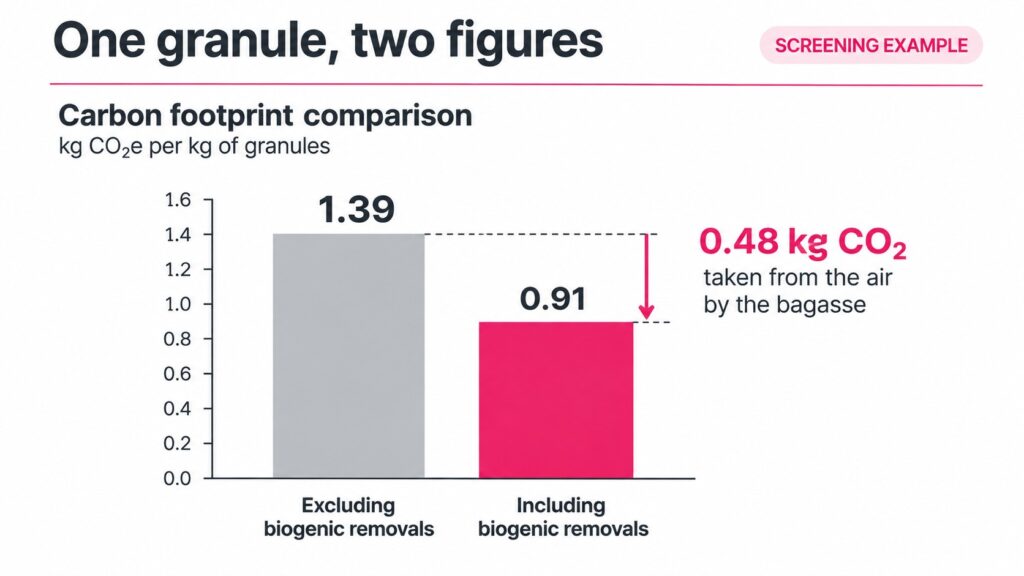
A screening example, with the values of our calculator (indicative, not a product footprint):
| PP with 30 % sugarcane bagasse, per kg of granules | Screening value |
|---|---|
| Footprint excluding biogenic removals (0.7 × 1.9 + 0.3 × 0.2) | about 1.39 kg CO₂e |
| CO₂ taken from the air by the bagasse (0.3 kg × about 1.6 kg CO₂ per kg) | about 0.48 kg CO₂ |
| Footprint including biogenic removals | about 0.91 kg CO₂e |
Both figures can come from the same ISO 14067 study, but they answer different questions, and comparing one supplier’s figure excluding removals with another’s including them is a common mistake.
The figure including removals also depends on what happens to the product later. In a durable part, such as a car interior component, the plant carbon stays stored for the life of the product. When a compostable product is composted, its plant carbon returns to the soil; the benefit is plant-based rather than fossil carbon, not long-term storage. A cradle-to-grave footprint counts that release at end of life.
Two more choices weigh on the result for biomass-filled materials:
- Residue or co-product. Some studies count agricultural residues such as bagasse at zero burden, as a waste of sugar production. Reference databases such as ecoinvent treat bagasse as a co-product and allocate part of the sugarcane’s emissions to it. The study should say which approach it uses.
- Land-use change. ISO 14067 has specific rules for emissions from land-use change, which matter most for polymers made from dedicated crops.
For bio-based plastics, the ISO 22526 series adds rules specific to plastics: part 2 measures the CO₂ removed from the air and incorporated into the polymer, and part 3 calculates the process carbon footprint as a partial footprint under ISO 14067.
ISO 14067, GHG Protocol, PEF and PACT: how they fit together
Customers do not all name the same framework. This is how the main ones relate to ISO 14067:
| Framework | What it is | Relation to ISO 14067 |
|---|---|---|
| ISO 14067:2018 | International standard for product carbon footprints | The reference |
| GHG Protocol Product Standard (2011) | Product life cycle accounting standard from WRI and WBCSD | Very close method; being aligned with ISO 14067 by a joint working group |
| ISO 14064-1 | Greenhouse gas inventory of an organization | Company level, not product level. Your customers build part of their Scope 3 from product footprints |
| PEF, Recommendation (EU) 2021/2279 | EU Product Environmental Footprint method, 16 impact categories | Climate change is one of the 16, with its own rules, such as the Circular Footprint Formula for recycling. Results are not directly interchangeable |
| PACT Methodology (WBCSD, version 3, 2025) | Rules for calculating and exchanging cradle-to-gate PCFs | Each PCF states the standards it follows, such as ISO 14067 |
| TfS PCF Guideline (version 3.0, 2024) | Chemical industry guideline from Together for Sustainability | Compliant with ISO 14067 and the GHG Protocol |
In the automotive industry, the Catena-X PCF Rulebook plays the same role as TfS does in chemicals. Whatever the framework your customer names, an ISO 14067 study with clear documentation is the common base.
Is there an ISO 14067 certification?
Not in the sense of a management system certificate such as ISO 9001. ISO 14067 is a calculation standard, and a footprint gains credibility in two ways:
- Critical review (clause 8 of ISO 14067): an expert or panel not involved in the study checks that it follows the standard.
- Third-party verification: a verification body accredited under ISO 14065 checks the study, data and calculations against ISO 14067, following ISO 14064-3, and issues a verification statement.
What is often called “ISO 14067 certification” is this verification statement. It covers one product or a defined set of products, not the company. ISO 14067 also describes a CFP systematic approach (Annex C): a company can have its calculation system checked, then produce footprints for many products with it.
Why it matters for climate claims in the EU. Since 27 September 2026, Directive (EU) 2024/825 has banned claims that a product has a neutral, reduced or positive climate impact when the claim rests on carbon offsetting. Claims based on the product’s actual life cycle emissions are outside that ban, but they must still be accurate and backed by evidence. A documented ISO 14067 study, critically reviewed or verified, is the usual way to provide that evidence. Our PPWR guide covers the other EU rules for packaging materials.
What to ask your plastic supplier
A PCF is only comparable when you know how it was built. Ask for:
- the value in kg CO₂e per kg and the system boundary (cradle-to-gate, with or without transport to you);
- whether the figure includes or excludes biogenic removals, and the biogenic carbon content of the material;
- the standard and version used (ISO 14067:2018, PACT, TfS) and the LCA database and version;
- the share of primary data from the supplier’s own site;
- the allocation method, especially for recycled content and agricultural residues;
- the electricity data used (grid average or supplier-specific);
- the date of the calculation, and whether it was reviewed or verified, and by whom;
- whether it covers the exact grade you buy or an average across a product family.
Compare two figures only when they share the same boundary, unit and rules: ISO 14067 sets the conditions for comparisons in its Annex B. The standard sets no expiry date, but sector guidelines do: TfS treats supplier PCFs as valid for up to three years. A change of raw material, energy contract or formulation is a reason to update sooner.
Where Biomera stands
Biomera develops materials made from upcycled agricultural biomass for injection molding and extrusion. The footprint of these materials is quantified per ISO 14067 on request:
- Free calculator. Our carbon footprint calculator gives indicative cradle-to-gate values in minutes, from public LCA sources, so you can compare options yourself. It is a starting point, not an ISO 14067 footprint.
- A PCF for the material we develop with you. Its cradle-to-gate footprint is calculated per ISO 14067, with fossil and biogenic carbon reported separately and the reference material named.
- Bio-based masterbatch. Blended into PP or PE for durable parts, it lowers the fossil share, and the plant carbon it contains stays stored for the life of the product. A masterbatch with a high biogenic carbon content can reach a carbon-negative cradle-to-gate footprint where an LCA shows it. More on the term in What is a carbon-negative material?
- Compostable compounds. The home compostable compound is certified OK compost HOME and OK compost INDUSTRIAL (TÜV Austria) and ASTM D6400 (BPI). Its carbon is plant-based rather than fossil, and it returns to the soil through certified composting.
Frequently Asked Questions
What is ISO 14067?
ISO 14067:2018 is the international standard for quantifying the carbon footprint of a product: the sum of its greenhouse gas emissions and removals, in kg CO₂e. It builds on the life cycle assessment standards ISO 14040 and ISO 14044, covers climate change only and excludes offsetting.
Is ISO 14067 a certification?
No. It is a calculation standard, not a management system. A footprint can be critically reviewed, or verified by an accredited body under ISO 14064-3, which issues a verification statement for the products covered.
What is the difference between ISO 14067 and ISO 14064?
ISO 14067 covers the footprint of a product over its life cycle. ISO 14064-1 covers the greenhouse gas inventory of an organization, and ISO 14064-3 sets out how greenhouse gas statements, including product footprints, are verified.
What is a partial carbon footprint?
A footprint that covers selected stages of the life cycle, usually from raw materials to the factory gate (cradle-to-gate). It is the normal format for materials such as plastic granules, whose use and end of life the supplier does not control.
How does ISO 14067 treat biogenic carbon?
It counts removals and emissions of biogenic carbon but requires them to be documented separately from fossil emissions. For a bio-based or biomass-filled plastic, ask whether a cradle-to-gate figure includes or excludes biogenic removals: both are possible, and they can differ by a third or more.
How long is a product carbon footprint valid?
ISO 14067 sets no expiry date. The chemical industry’s TfS guideline treats supplier PCFs as valid for up to three years, and a change in raw materials, energy or formulation calls for an update sooner.
Share the Post: