GreenHub
Microplastic-Free Materials: What EU Regulation Says
Microplastic-free materials, in EU law, are materials whose polymer falls outside the definition used by REACH restriction 2023/2055: a natural polymer that has not been chemically modified, a polymer proven degradable by the tests the regulation lists, a soluble polymer, or a polymer without carbon. Any other plastic present as particles of 5 mm or less is legally a microplastic, including the pellets delivered to processors.
The request now shows up regularly in specifications. Yet it covers three different issues, governed by three different texts. This guide separates them, gives the dates that apply and explains what a certificate actually proves.
Key points
- Since 17 October 2023, REACH restriction 2023/2055 has been phasing out microplastics intentionally added to products: microbeads and loose glitter first, rinse-off cosmetics in 2027, detergents in 2028, leave-on cosmetics in 2029.
- Plastic pellets are microplastics under REACH. Using them at industrial sites is still allowed, but since 17 October 2025 suppliers must provide instructions for use and disposal, and manufacturers and industrial users report their estimated releases to ECHA every year by 31 May.
- A molded part is an article: it falls outside the restriction.
- Regulation (EU) 2025/2365 on pellet losses applies from 17 December 2027 to every operator handling 5 tonnes or more a year. France has required similar measures by decree since 2022.
- A compostability certificate is not enough to take a polymer out of the REACH definition, and PLA and PHA count as synthetic polymers there.
Microplastic-free materials: what exactly are we talking about?
When a buyer asks for a microplastic-free material or polymer, they usually mean one of three risks:
- Intentionally added microplastics. Polymer particles deliberately added to a product (exfoliants, glitter, fertilizer coatings). This is the scope of REACH restriction 2023/2055.
- Pellet losses. Pellets lost during production, storage or transport. This is covered by Regulation (EU) 2025/2365 and, in France, by Decree No. 2021-461.
- Fragments from a product at end of life. An object that breaks up in the environment releases so-called secondary microplastics. Here, what counts is the product’s composition and its end of life: composting, biodegradation, recycling.
The same material can be beyond reproach on one point and in scope on another. So it pays to state which of the three you mean before comparing suppliers.
REACH restriction 2023/2055 in brief
Regulation (EU) 2023/2055 added entry 78 to Annex XVII of REACH. It targets synthetic polymer microparticles: a solid polymer, contained in particles or forming a continuous coating on them, where at least 1% by weight of those particles measure 5 mm or less in all dimensions (or 15 mm in length for fiber-like particles).
Four families of polymers are excluded from the definition:
- polymers that result from a polymerization process that took place in nature, whatever the extraction process, and that have not been chemically modified;
- polymers proven degradable under Appendix 15 of the regulation;
- polymers with a solubility above 2 g/L under Appendix 16;
- polymers that contain no carbon atoms.
The ban covers placing these microparticles on the market, on their own or in mixtures, at a concentration of 0.01% by weight or more, when they are added to give a sought-after property. According to the European Commission, the measure should prevent the release of about half a million tonnes of microplastics into the environment. The timetable depends on the product:
| Products | Banned from |
|---|---|
| Microbeads, loose glitter and products without a transition period | 17 October 2023 |
| Rinse-off cosmetics | 17 October 2027 |
| Detergents, waxes, polishes and air care products | 17 October 2028 |
| Fertilizers outside Regulation (EU) 2019/1009, other agricultural and horticultural products | 17 October 2028 |
| Leave-on cosmetics, medical devices, fragrance encapsulation | 17 October 2029 |
| Plant protection products, treated seeds, biocides | 17 October 2031 |
| Granular infill for synthetic sports surfaces | 17 October 2031 |
| Make-up, lip and nail products | 17 October 2035 |
Pellets, powders, masterbatch: what changes for manufacturers
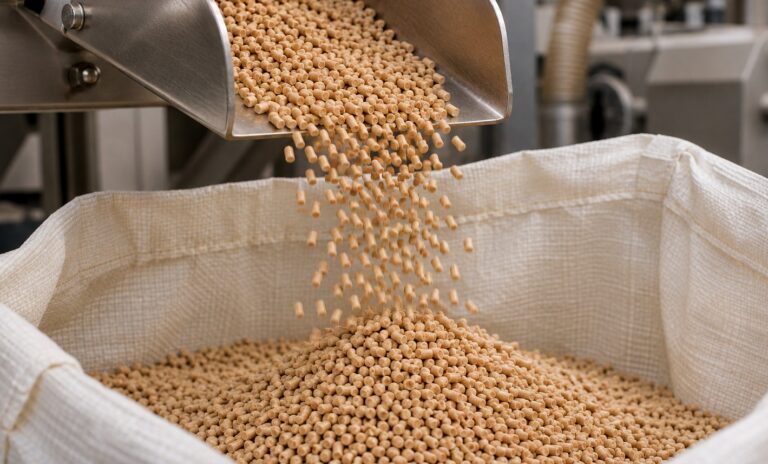
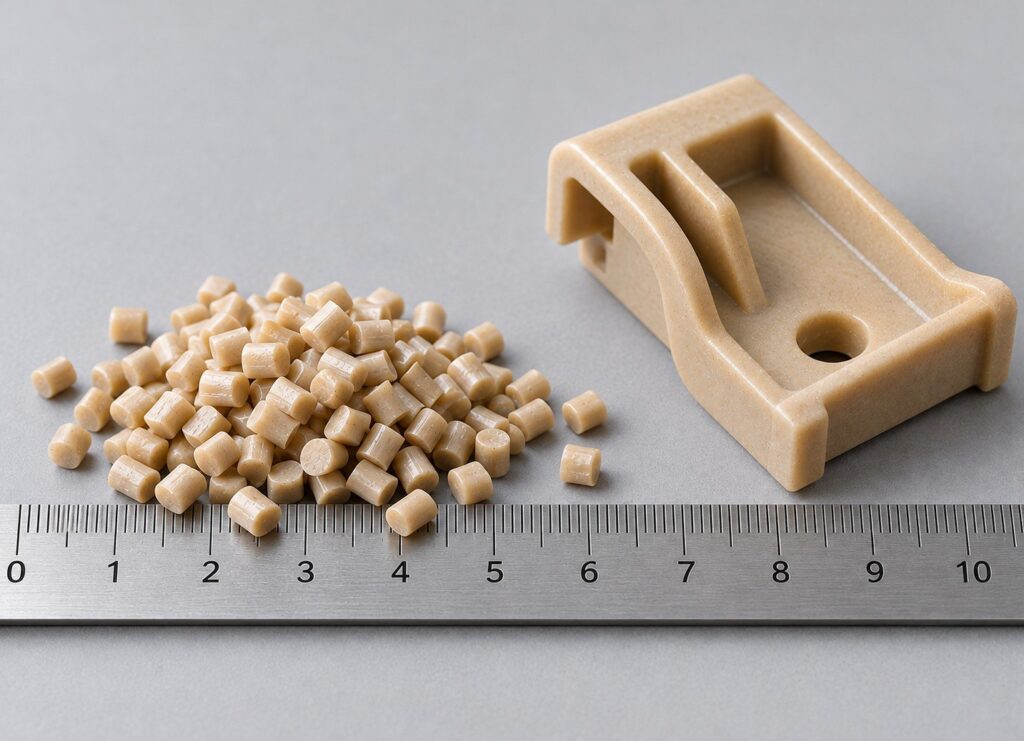
A compound or masterbatch pellet usually measures a few millimeters. Unless its polymer is one of the exclusions, it is therefore a synthetic polymer microparticle, and not a microplastic-free material under REACH. The regulation does not ban it for all that: use at industrial sites benefits from a derogation (paragraph 4, point a). That derogation comes with two obligations.
Since 17 October 2025, information from the supplier. Any supplier of pellets, flakes or powders intended for an industrial site must give its customers:
- instructions for use and disposal explaining how to avoid releases;
- a statement referring to entry 78 of REACH Annex XVII;
- the quantity or concentration of microparticles;
- generic information on the identity of the polymers.
In practice, this information often sits in the safety data sheet or in a dedicated sheet.
Every year by 31 May, a report to ECHA. Manufacturers and downstream industrial users of pellets, flakes and powders used as raw materials in plastics manufacturing have reported since 2026 (2025 data) their uses, the polymers concerned and their estimated releases, transport included. Other industrial users follow from 2027.
The finished part is not covered. The Commission’s guidelines point out that the restriction does not apply to articles, meaning objects whose shape or design determines their function more than their composition. Your injection-molded part is therefore not a microplastic under REACH. The pellets used to make it are.
Pellet losses: Regulation (EU) 2025/2365 and the French decree
According to the Council of the European Union, between 52,140 and 184,290 tonnes of pellets were lost to the environment in the EU in 2019. Regulation (EU) 2025/2365, adopted on 12 November 2025, aims to cut these losses at the source. France got there first with Decree No. 2021-461.
| Regulation (EU) 2025/2365 | Decree No. 2021-461 (France) | |
|---|---|---|
| Who is covered | Operators that handled 5 tonnes of pellets or more in the previous calendar year (production, processing, recycling, storage), EU and non-EU carriers, tank cleaning, maritime transport | Production, handling and transport sites where more than 5 tonnes of pellets may be present, container washing areas |
| Timetable | In force since 16 December 2025, applies from 17 December 2027, from 17 December 2028 for maritime transport | In force since 1 January 2022 (1 January 2023 for equipment at sites operating before 2021) |
| Main obligations | Risk management plan for each installation, prevention, containment and clean-up equipment and procedures, self-declaration of conformity, annual record of estimated losses, incident reporting within 30 days | Equipment against releases, containment and recovery devices, written procedures, staff training, internal checks every six months |
| External check | Above 1,500 tonnes a year, a certificate from an accredited body: by 17 December 2027 for large companies (then every 3 years), 17 December 2028 for medium-sized ones (every 4 years), 17 December 2030 for small ones (valid 5 years). Below that threshold, and for micro-enterprises, a self-declaration renewed every 5 years | Audit by an accredited certification body within a year of implementation, then at least every 3 years, with a summary published on the operator’s website |
So for plastics processors in France, the EU regulation does not start from scratch: sites already audited under the decree have most of the expected equipment and procedures in place.
Compostable, biodegradable, natural: what each certificate proves
This is where most of the confusion lies. Appendix 15 of the REACH restriction lists the tests that can prove a polymer degradable: ready biodegradability tests in water (OECD 301, 306, 310), an inherent biodegradability test (OECD 302C), tests in water, sediment or soil (EN ISO 14851, 14852, 17556, 19679, 18830, ISO 22404) and simulation tests (OECD 307, 308, 309). For most uses, the relative and simulation tests must be passed in water, sediment and soil. No composting test appears on that list.
| Evidence | What it shows | Does it take the polymer out of the REACH definition? |
|---|---|---|
| EN 13432 / OK compost INDUSTRIAL | At least 90% biodegradation in 6 months at 58 °C, less than 10% of fragments over 2 mm after 12 weeks of industrial composting, no effect on compost quality | No, not on its own |
| OK compost HOME (TÜV Austria) | At least 90% biodegradation in 12 months at 20 to 30 °C, disintegration in 6 months at most | No, not on its own |
| OK biodegradable SOIL, WATER or MARINE | Biodegradation in soil, fresh water or seawater, under TÜV Austria’s criteria | Not automatically: the test and threshold must match Appendix 15, in every environment required |
| Appendix 15 tests | Degradation in water, sediment or soil against the regulation’s thresholds | Yes, if the criteria are met |
| Natural polymer, not chemically modified | Polymerization that took place in nature (unmodified cellulose or lignin, for example) | Yes |
Two practical consequences follow:
- PLA and PHA are synthetic polymers under REACH. The Commission’s guidelines state that a polymer whose polymerization takes place in a laboratory or a plant, including by industrial fermentation, is synthetic even if its structure mimics a natural polymer.
- Composting remains a strong argument for secondary microplastics. A certified compostable product disintegrates and then biodegrades under the composting conditions tested. That is exactly what you want from an object that may escape waste sorting. It simply is not the same question as the REACH definition. To go further: bio-based, biodegradable, compostable: what’s the difference?
Can you write “microplastic-free” on a product?
Yes, provided you can say exactly what the claim covers. Since 27 September 2026, Directive (EU) 2024/825 has banned generic environmental claims without recognized excellent environmental performance, and any specific claim must be precise and verifiable. In France, the AGEC law has also banned the terms “biodegradable” and “environmentally friendly” on products and packaging since 2022, a ban upheld by the Conseil d’État in 2024.
A few examples:
- Avoid: “Microplastic-free material”, with nothing else. Nobody knows which definition is meant or what evidence exists.
- Avoid: “Biodegradable” on a product or packaging sold in France.
- Defensible: “Certified OK compost HOME (TÜV Austria): disintegrates in home composting without leaving microplastics.”
- Defensible, if true: “Natural polymer, not chemically modified, outside the scope of REACH restriction 2023/2055.”
These examples are not legal advice, but they show the logic: a solid claim names the standard, the environment and the level (material or product) it covers. For single-use packaging and tableware, see also our guide to the SUP Directive.
Questions to ask your material supplier
Before you approve microplastic-free materials in a specification, ask these six questions:
- Does the polymer fall within the definition of synthetic polymer microparticles? If not, on what basis: unmodified natural polymer, Appendix 15 tests, solubility?
- Do you provide the instructions for use and disposal and the statement referring to REACH entry 78?
- What data can you give me for my annual report to ECHA?
- Which compostability or biodegradability certificate covers the material, for which environment, and is it issued at material or finished-product level?
- Does your production site apply French Decree No. 2021-461, or is it preparing for Regulation (EU) 2025/2365?
- Which claim wording can you back up in writing?
Where Biomera stands
Biomera develops materials made from upcycled biomass for injection molding and extrusion. For anyone looking for microplastic-free materials, each range answers differently:
- Compostable compounds. The home compostable compound is certified OK compost HOME and OK compost INDUSTRIAL (TÜV Austria) as well as ASTM D6400 (BPI); the industrial compostable compound is certified EN 13432 (DIN CERTCO). They disintegrate in certified composting without leaving microplastics. The first is designed for products that may escape the user’s control after use, the second for short-life products collected for industrial composting. To choose between them: home or industrial compostable?
- Bio-based masterbatch. Blended into PP or PE, it gives a durable part and reduces the share of fossil polymer. For these parts, the issue is not biodegradation but carbon footprint and service life: see our guide to low carbon polymers.
- The V3 platform, in development. A natural polymer, designed to fall outside the plastic definition of the SUP Directive, with samples planned in 2027 for our development partners. Our roadmap to plastic-free materials sets out the steps.
Frequently Asked Questions
What is a microplastic-free material?
Under EU law, it is a material whose polymer falls outside the definition used by REACH restriction 2023/2055: a natural polymer that has not been chemically modified, a polymer proven degradable under Appendix 15, a polymer with a solubility above 2 g/L, or a polymer without carbon. A specification should also state whether it refers to added microplastics, pellet losses or fragments from the product at end of life.
Are plastic pellets microplastics?
Yes, under REACH, as long as their polymer is not excluded and they measure 5 mm or less. Using them at industrial sites is still allowed, but since 17 October 2025 suppliers must provide instructions for use and disposal, and manufacturers and industrial users report their estimated releases to ECHA every year by 31 May. The molded part is an article and falls outside the restriction.
Is a compostable plastic excluded from the microplastics restriction?
Not automatically. The tests that can exclude a polymer are listed in Appendix 15 and cover water, sediment and soil; no composting test is included. An EN 13432 or OK compost HOME certification does prove that the product disintegrates and biodegrades in composting, which answers the question of fragments at end of life.
Are PLA and PHA natural polymers under REACH?
No. The European Commission’s guidelines treat as synthetic any polymer whose polymerization takes place in a laboratory or a plant, including by industrial fermentation, even if its structure mimics a natural polymer. PLA and PHA can therefore only fall outside the definition by proving their degradability under Appendix 15.
Who is covered by the regulation on plastic pellet losses?
Regulation (EU) 2025/2365 applies from 17 December 2027 to operators that handled at least 5 tonnes of pellets in the previous year, and to carriers, including non-EU ones. Above 1,500 tonnes a year, a certificate from an accredited body is required. In France, Decree No. 2021-461 has required equipment, procedures and audits since 2022.
Can you write “microplastic-free” on a product or packaging?
Yes, if the claim is precise and verifiable: it must say which definition or standard it refers to and what evidence supports it. Since 27 September 2026, Directive (EU) 2024/825 has banned generic environmental claims. In France, the term “biodegradable” is also banned on products and packaging.