GreenHub
PPWR: What It Changes for Compostable and Bio-Based Packaging
The PPWR (Packaging and Packaging Waste Regulation, Regulation (EU) 2025/40) has applied across the EU since 12 August 2026. It decides which packaging must be compostable, which must be recyclable, how much recycled plastic it must contain and which substances it may not contain. For compostable and bio-based materials, it opens some doors and closes others, sometimes in the same article.
This guide sets out what the PPWR changes for compostable packaging and bio-based plastics, with the dates that apply and the questions to put to your material supplier.
Key points
- From 12 February 2028, permeable tea and coffee bags, soft single-serve units and sticky labels on fruit and vegetables must be compostable in industrial conditions (Article 9).
- Compostable plastic is still plastic: from 1 January 2030, the Annex V bans on six single-use formats apply to it too, unless a Member State requires compostable packaging instead, as Italy has done.
- Compostable plastic packaging is exempt from the recycled content targets of Article 7 (between 10 and 35% from 2030, depending on the packaging).
- Since 12 August 2026, food-contact packaging may not contain PFAS above 25 ppb per substance, 250 ppb in total, or 50 ppm including polymeric PFAS (Article 5).
- Bio-based plastic does not count as recycled content. The Commission is reviewing it under Article 8 and consulting stakeholders until 13 January 2027.
What is the PPWR?
The PPWR is an EU regulation, not a directive: it applies directly in every Member State, without being written into national law first. It was published in the Official Journal on 22 January 2025, entered into force on 11 February 2025 and has applied since 12 August 2026. Most of its obligations then phase in between 2028 and 2040.
It covers all packaging placed on the EU market, whatever the material, and everyone who makes, imports or sells it. Material suppliers are concerned too, if indirectly: a packaging maker has to show that its packaging meets the requirements, and in practice it asks its material supplier for the evidence. The questions at the end of this guide come from there.
The Single-Use Plastics Directive (2019/904) stays in force alongside the PPWR. Our guide to the SUP Directive covers the bans and marking rules that come from that text.
PPWR timeline for packaging materials
These are the dates that matter when you choose a material:
| Date | What applies | Article |
|---|---|---|
| 12 August 2026 | General application of the PPWR; PFAS limits in food-contact packaging | Art. 5 |
| 12 February 2028 | Tea and coffee bags, soft single-serve units and fruit and vegetable labels must be compostable | Art. 9 |
| 12 February 2028 | Commission review of bio-based plastic packaging | Art. 8 |
| 2028 | Harmonised labels showing what the packaging is made of | Art. 12 |
| 1 January 2030 | All packaging recyclable (performance grades A to C); minimum recycled content in plastic packaging; bans on the formats in Annex V | Art. 6, 7, 25 |
| 2035 | Recyclability judged on actual recycling at scale | Art. 6 |
| 2038 | Only grades A and B accepted | Art. 6 |
| 1 January 2040 | Higher recycled content targets (25 to 65%) | Art. 7 |
The 2030 dates for Articles 6 and 7 can move back if the Commission’s implementing rules arrive late: recyclability applies 24 months after the delegated acts at the earliest, and recycled content depends on the calculation method being adopted.
Which packaging must be compostable under the PPWR?
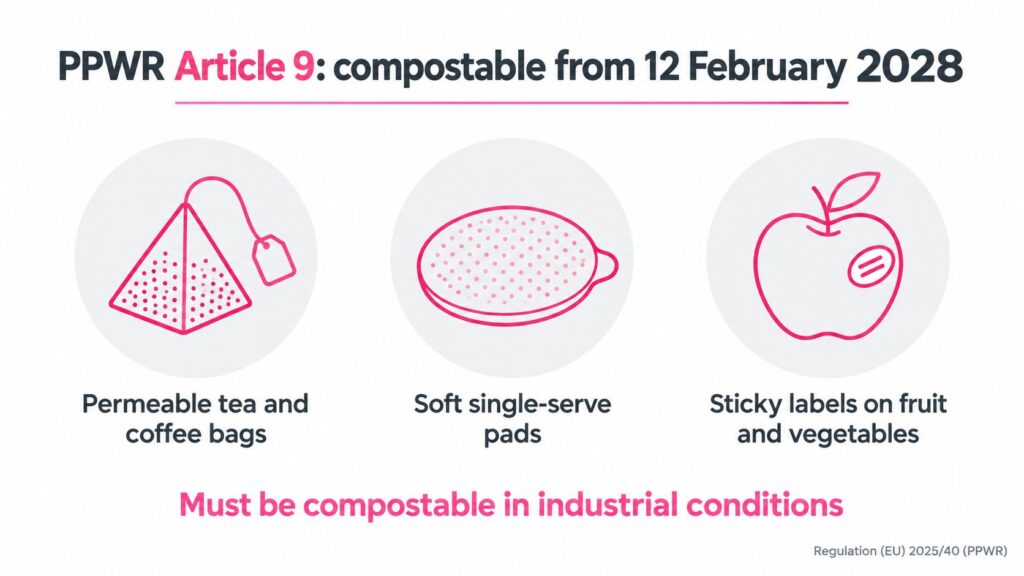
Article 9 is the only place where the PPWR requires compostable packaging. The list is short, and it applies from 12 February 2028:
- permeable tea, coffee or other beverage bags;
- soft single-serve units for tea, coffee or other drinks, used and thrown away together with the product;
- sticky labels attached to fruit and vegetables.
These formats must be compostable in industrially controlled conditions, in bio-waste treatment facilities. Home compostability is not required by default.
Member States can go further. They may require compostability for non-permeable tea and coffee units made of materials other than metal, for very lightweight and lightweight plastic carrier bags, and for packaging that their national law already required to be compostable before 12 August 2026. They may also ask for home compostability.
Everything else must be recyclable. Packaging outside the Article 9 list, including packaging made of compostable or biodegradable plastics, must be designed for material recycling under Article 6. Calling it compostable does not exempt it.
The standards will change. EN 13432 remains the reference for industrial compostability, but the harmonised standards are due to be updated, so the certificate expected in 2028 may differ from today’s. Compostable formats will also carry a label sending them to bio-waste collection rather than recycling. To compare the two certification routes: home or industrial compostable?
Compostable plastic is still plastic: bans and exemptions
The PPWR does not create a separate category for compostable plastics such as PLA, PBS or PBAT. Compostable plastic packaging remains plastic packaging, with a few specific rules:
| Rule | Does it apply to compostable plastic packaging? | What it means |
|---|---|---|
| Annex V bans (from 1 January 2030) | Yes | Six single-use formats are banned even when certified EN 13432: film multipacks, plastic trays and bags for fresh fruit and vegetables under 1.5 kg, plastic plates, cups, trays and boxes for eating on site, single portions of condiments served on site, hotel miniatures, very lightweight carrier bags under 15 microns. Most entries have exceptions |
| Recycled content (Article 7) | No, exempt | No minimum recycled content to reach |
| Recyclability (Article 6) | Only outside the Article 9 list | Article 9 formats are exempt; other compostable packaging must be designed for recycling |
| PFAS limits (Article 5) | Yes | Same limits as any food-contact packaging |
| Labelling (Article 12) | Yes | Composition label, plus collection instructions for compostable formats |
The Annex V bans leave one door open for compostable materials. Article 9 allowed a Member State to require compostable packaging for some of these formats instead, where bio-waste collection and treatment exist. Italy adopted a decree on 7 August 2026, notified to the European Commission, that requires certified compostable packaging (EN 13432) for fresh produce under 1.5 kg, certain single-use packaging in hotels and restaurants, and portion packs. Elsewhere, these formats will be banned from 2030 even when certified compostable, unless the country has used the same option.
PFAS in food-contact packaging: the limits since 12 August 2026
Article 5 limits PFAS in any packaging that comes into contact with food, whatever the material. The limits apply to the packaging itself, not to what migrates into the food, and they cover PFAS added on purpose as well as contamination:
| Measure | Limit |
|---|---|
| Any individual PFAS (targeted analysis, polymeric PFAS excluded) | 25 ppb (25 µg/kg) |
| Sum of PFAS measured by targeted analysis | 250 ppb (250 µg/kg) |
| Total PFAS, including polymeric PFAS | 50 ppm (50 mg/kg) |
The Commission’s guidance, published in March 2026, suggests testing in steps: total fluorine below 50 mg/kg can be considered compliant; above that, organic fluorine is measured; targeted analysis then checks the 25 and 250 ppb limits. Packaging placed on the market before 12 August 2026 can be sold until stocks run out.
In practice, “PFAS-free” on a data sheet is not enough. Ask for the test method and the measured value. A certificate built on a different threshold, such as 100 ppm of total organic fluorine, shows that no PFAS were added on purpose, but it does not prove on its own that the packaging meets the 50 ppm limit of the PPWR.
Bio-based plastics: what Article 8 could change
Today, the PPWR gives bio-based plastic no particular credit. The recycled content targets count post-consumer recycled plastic only, so a bio-based polymer or a biomass filler does not help to reach them.
That could change. Article 8 asks the Commission to review bio-based plastic packaging by 12 February 2028: how far the technology has come, how it performs for the environment, and whether targets for bio-based feedstock should follow, with sustainability requirements for the biomass. The Commission opened a public consultation on 21 October 2026, open until 13 January 2027, and a legislative proposal may follow.
For a manufacturer, the practical point today is simple. A bio-based masterbatch lowers the fossil share of a part and can lower its carbon footprint, but it does not change the part’s PPWR obligations: packaging must still be recyclable from 2030 and contain the required recycled content. Our guide to low carbon polymers explains how the footprint is measured.
PPWR checklist: questions to ask your material supplier
Before you approve a material for packaging sold in the EU, ask these six questions:
- Is the packaging format on the Article 9 list, or does it fall under the recyclability rule?
- Which compostability certificate covers the material (EN 13432, OK compost HOME or OK compost INDUSTRIAL), at material or finished-product level, and up to what thickness?
- For food contact: what is the measured total fluorine, by which method, and is it below 50 mg/kg?
- Is the format one of the six banned by Annex V from 2030, and in which countries will you sell it?
- For plastic packaging that must be recycled: what design-for-recycling grade can the part reach, and how much post-consumer recycled content can the material take?
- Which wording can you put on the packaging without breaking the rules on environmental claims (Directive (EU) 2024/825)?
For the wider selection method, see our technical framework for replacing plastics.
Where Biomera stands
Biomera develops materials made from upcycled biomass for injection molding and extrusion. Under the PPWR, each range answers a different question:
- Compostable compounds. The home compostable compound is certified OK compost HOME and OK compost INDUSTRIAL (TÜV Austria) and ASTM D6400 (BPI); the industrial compostable compound is certified EN 13432 (DIN CERTCO). They are the materials to consider for rigid formats that must or may be compostable, such as non-permeable single-serve units where a country requires it. The home compostable compound contains no intentionally added PFAS (BPI, under 100 ppm total organic fluorine); for food-contact packaging, the finished packaging still needs its own test against the PPWR limits.
- Bio-based masterbatch. Blended into PP or PE, it reduces the fossil share of durable parts that stay in the recycling route.
- The V3 platform, in development. A natural polymer, designed to fall outside the plastic definition of the SUP Directive, with samples planned in 2027 for our development partners. Our roadmap to plastic-free materials sets out the steps.
Frequently Asked Questions
What is the PPWR?
The PPWR is Regulation (EU) 2025/40 on packaging and packaging waste. It has applied directly in every EU Member State since 12 August 2026 and sets rules on substances, recyclability, recycled content, compostability, labelling, reuse and banned formats, phased in between 2026 and 2040.
Which packaging must be compostable under the PPWR?
From 12 February 2028, Article 9 requires permeable tea, coffee or other beverage bags, soft single-serve units used and disposed of with the product, and sticky labels on fruit and vegetables to be compostable in industrial conditions. Member States may add other formats, such as non-permeable tea and coffee units or lightweight carrier bags.
Does the PPWR ban compostable plastic packaging?
Not as such, but compostable plastic is still plastic. The six single-use formats listed in Annex V are banned from 1 January 2030 even when they are certified compostable, unless a Member State requires them to be compostable instead, as Italy did in August 2026.
Is compostable plastic packaging exempt from the PPWR recycled content targets?
Yes. The minimum recycled content targets of Article 7, between 10 and 35% from 2030 depending on the packaging, do not apply to compostable plastic packaging. Its other obligations, such as the PFAS limits and labelling, still apply.
What are the PPWR PFAS limits for food-contact packaging?
Since 12 August 2026: 25 ppb for any individual PFAS, 250 ppb for the sum of PFAS measured by targeted analysis, and 50 ppm for total PFAS including polymeric PFAS. The Commission’s guidance suggests starting with a total fluorine test below 50 mg/kg.
Does bio-based plastic count toward PPWR recycled content?
No. Only post-consumer recycled plastic counts. The Commission is reviewing bio-based plastic packaging under Article 8, with a deadline of 12 February 2028, and is consulting stakeholders until 13 January 2027.