GreenHub
Bioplastic Manufacturer, Compounder or Supplier: How to Choose
Search for a “bioplastic manufacturer” and you will find companies doing very different things. Some make the base polymer. Some resell it. Others formulate materials from it, and a few will develop a new material around your requirements. They all show up under the same phrase, but they solve different problems.
Picking the wrong kind of partner is one of the most common reasons a sustainable-material project stalls. Usually the material was fine; the supplier’s role just never matched what the project needed. This guide walks through the roles in the bioplastics value chain, what you actually buy from each, and how to match the partner to your objective.
What a “bioplastic manufacturer” really is
“Bioplastic” is a broad industry word. It usually covers materials that are bio-based, biodegradable, or both, which makes it handy for search and useless as a specification. A bio-based material is not automatically compostable. A compostable material is not automatically bio-based. And a biocomposite is a material category, not an end-of-life claim. The word “manufacturer” hides at least four different roles too.
The four roles in the value chain
Most of the confusion clears up once you separate who makes the polymer from who turns it into a usable material. A polymer producer is not “less sophisticated” than a compounder, and a compounder is not automatically the greener option. The roles are simply different, and the right one depends on your project.
| Role | What they provide | Best when you need | What to verify |
|---|---|---|---|
|
Polymer producer |
Base polymers made by polymerization or fermentation (PLA, PHA, PBS, PBAT, bio-PE) |
A known, standard resin grade in volume, to a fixed specification |
Grade datasheet, availability, minimum order, application support |
|
Distributor |
Stock and supply of polymers and additives from several producers |
Access to multiple resins without qualifying each producer |
Grades carried, lead time, support depth, documentation |
|
Compounder / formulator |
Ready-to-process compounds and masterbatches combining polymers with fillers, fibers, additives |
A material tuned to your polymer, process and performance targets |
Formulation capability, in-house testing, process data, evidence scope |
|
Material-development partner |
Co-development of a new material to meet objectives an off-the-shelf grade cannot |
Several objectives at once (performance, biomass, appearance, compliance, end-of-life) |
Development method, trial support, scale-up route, what stays proprietary |
Polymer, compound or masterbatch: what you actually buy
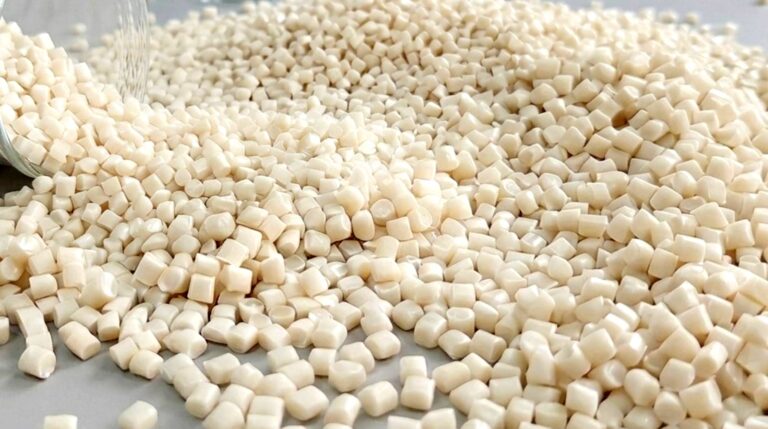
A polymer is the base resin. A compound is finished pellets: a polymer already mixed with fillers, fibers or additives and ready to run on your line. A masterbatch is a concentrate you add to your own resin at a set ratio, so you keep your polymer supply and change only part of the material. Whether a finished part ends up bio-based, low-carbon or compostable depends on the whole formulation and the final article, not on any single ingredient. Our guide on bio-based compound vs masterbatch goes into the detail.
Standard polymer sourcing works well when the material is already defined. You know the grade, the specification is fixed, and you just need reliable supply. Formulation earns its keep when the requirements pull against each other, so that biomass content, mechanical performance, processability, appearance, heat resistance, compostability and compliance all have to be balanced in one material. The useful question is not “who is the best manufacturer” but “is my material already defined, or does it still need to be designed?”
Match the objective to the pathway
Different objectives lead to different material pathways, and no single material satisfies all of them. Start from the objective, not the material label:
| Your objective | A likely material pathway | Type of partner |
|---|---|---|
|
A specific, known standard resin grade in volume |
Buy the qualified grade as-is |
Polymer producer or distributor |
|
Reduce fossil content while keeping your existing PP or PE |
Add a biomass masterbatch to your current resin |
Compounder / formulator |
|
A finished part that is home or industrial compostable |
Select or develop a certified compostable compound |
Compounder with compostability evidence |
|
Introduce natural fiber or biomass without losing processability |
Engineer a biocomposite compound for your process |
Formulator with biocomposite capability |
|
Meet several targets at once (performance + biomass + appearance + compliance) |
Co-develop a material to the full brief |
Material-development partner |
What to ask any material supplier
Whatever role a supplier plays, a short and consistent set of questions tells you quickly whether they can serve your project. You do not need a full proprietary formulation. You need enough to judge compatibility, compliance and sustainability.
- Composition and identity. Which polymer family, and what type of filler or fiber, in enough detail to check compatibility and compliance.
- Process fit. Injection, extrusion or both, with the conditions and test methods behind the published values.
- Performance evidence. Measured properties with the test method stated, tied to a named grade.
- End-of-life scope. If a material is compostable, ask to which standard and scheme (EN 13432, OK compost HOME), at material or finished-article level, and with what thickness limits. A material certificate does not certify your finished part.
- Sustainability basis. Is a carbon claim about fossil-content reduction (a fact about composition) or a measured footprint (assessed to a standard such as ISO 14067, within a stated boundary)? Lower fossil content does not by itself prove a lower footprint.
- Supply and scale. Available forms, trial quantities, and the route from sample to production.
Where the interface changes the compounding conversation
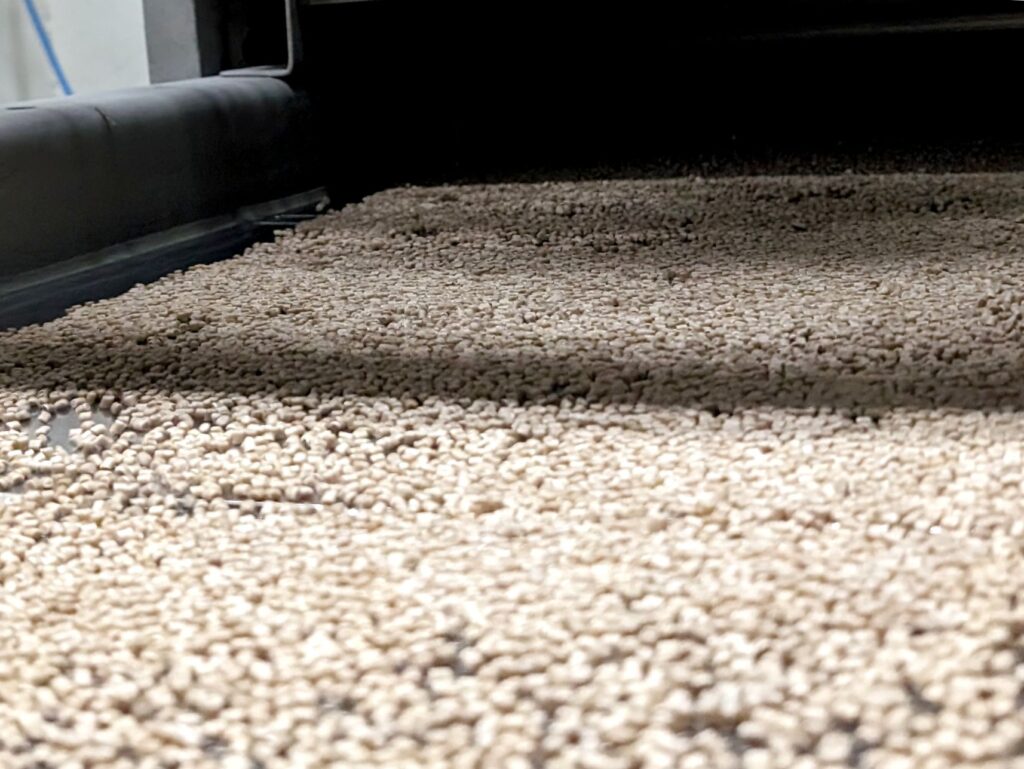
Plenty of biomass-filled materials are made by melt-blending fiber into polymer, sometimes with a standard coupling agent. What really governs the result is the interface between fiber and polymer: how well they bond, how evenly the fiber disperses, and how the fiber holds up at processing temperatures. That interface drives the dispersion, thermal stability and mechanical properties of the finished compound. Treating it as a design problem, instead of a fixed additive, is what separates a simple blend from an engineered biocomposite.
It matters when you choose a partner, because it sets how far a material can be pushed and whether it can be adapted as your polymer, process or target changes.
Where Biomera fits
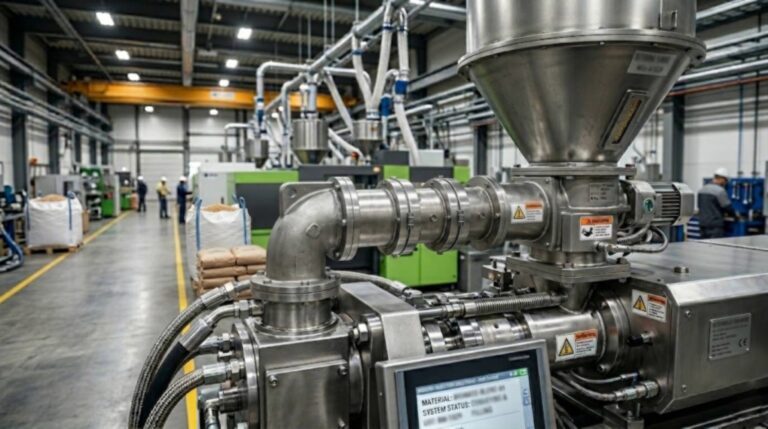
Biomera is a formulation and material-development partner. We do not polymerize base resins such as PLA, PHA, PBS or polyolefins. We select them, combine them, and engineer materials around them, supplied as ready-to-process compounds and bio-based masterbatches for injection molding and extrusion.
Two things define our role. The first is breadth of pathway. We work across conventional, recycled, bio-based and compostable systems, from stock-referenced grades to fully custom development, so the route follows your objective rather than one house material. That runs from our certified, PLA-free home-compostable compound to bio-based masterbatches formulated for your specific polymer. The second is interfacial engineering. Before compounding, we prepare and treat the fiber so it works with the chosen polymer and processing window, using surface activation, functionalization and compatibilization designed for each combination of fiber chemistry, polymer matrix and process. This is proprietary know-how, not a single coupling agent, and it is meant to improve fiber dispersion, bonding between fiber and polymer, thermal stability and final mechanical properties. There is more on our technology page.
Frequently Asked Questions
Does “bioplastic manufacturer” mean a company that makes the polymer?
Not always. The phrase gets used for polymer producers, distributors, compounders and material-development partners alike. Only a polymer producer actually makes the base resin by polymerization or fermentation. The rest source it, formulate with it, or develop materials from it.
What is the difference between a compound and a masterbatch?
A compound is finished pellets you can run straight on your line. A masterbatch is a concentrate you add to your own resin at a set ratio. A compound changes the whole material; a masterbatch adjusts the resin you already use.
Who adapts a formulation to my polymer and process?
A compounder or a material-development partner. Polymer producers supply defined grades. Adapting a material to your specific resin, process window and performance targets is a formulation job.
Is a bio-based material the same as a compostable one?
No. Bio-based refers to where the material comes from. Compostable refers to how it breaks down under defined conditions and standards. A material can be bio-based without being compostable, and compostable without being fully bio-based.
What do you need for an initial feasibility review?
Usually your current resin if you have one, the process (injection or extrusion), your target properties or objective, the application and target market, an approximate annual volume, and any end-of-life or regulatory requirement. A drawing or datasheet helps, but you do not need one to start.
Choosing the right partner. Match the partner to the state of your material, not to the biggest name under “bioplastic manufacturer.” If your grade is already defined, buy it from a producer or distributor. If it still has to be balanced across performance, biomass, process and compliance, work with a formulator or development partner who can show measured evidence, state the scope of every claim, and take you from trial to production.
Share the Post: